
Rental LED Screen Technical Guide: Refresh Rate, Viewing Angle, and Cabinet Parameters
A rental LED screen is judged twice: once by the audience inside the venue, and once by the camera feeding the live stream or the image-magnification screen. A wall that looks smooth in the hall can band on a broadcast feed, and a cabinet layout that fits the stage can leave the side audience watching a dim edge. Refresh rate, viewing angle, and cabinet geometry — size, structure and installation method — explain most of those outcomes.
This guide treats those three parameters as selection criteria rather than sales features. It uses the DDW DISPLAY D Series rental LED screen as the reference product because its configuration covers the range most event work falls into: P1.56, P1.95, P2.604, P2.97 and P3.91 pixel pitches, a 500 × 500 mm cabinet, an H160°/V140° viewing angle, refresh rates up to 7680 Hz, a die-casting aluminum cabinet, and hanging or stacking installation.
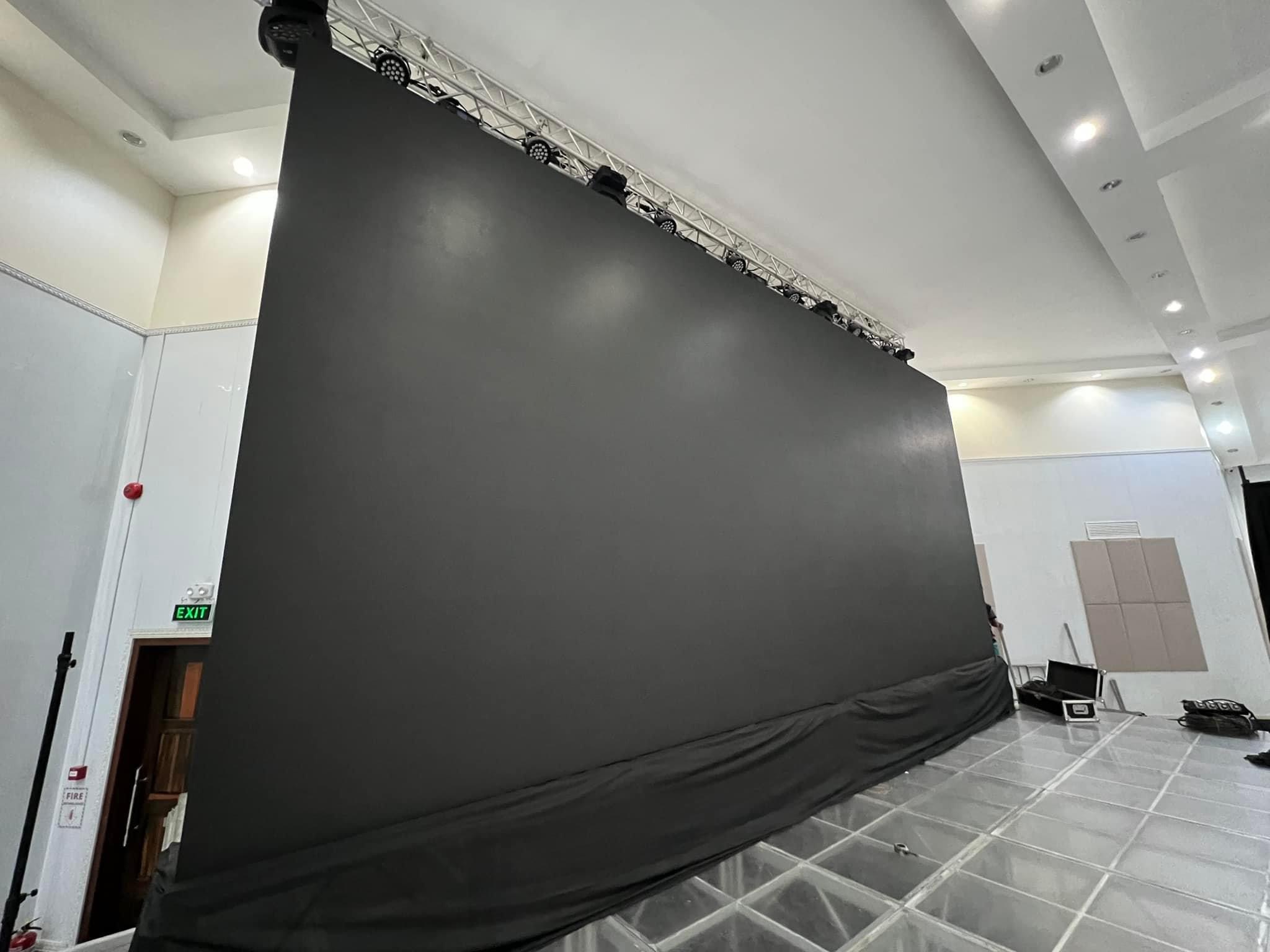
Why Rental LED Specifications Are Easy to Misread
A rental specification sheet compresses four different kinds of information into one table, and they do not behave the same way in a venue. Pixel pitch describes how much image detail a cabinet can hold. Refresh rate describes how the screen behaves in time. Viewing angle describes how the emitted image spreads through space. Cabinet parameters describe what happens during transport, assembly, and repeated load-ins.
The practical consequence is that a single number rarely answers a procurement question. Two walls with the same pixel pitch can produce different camera results if their refresh rates and control configurations differ. Two walls with identical cabinets can serve different audience layouts depending on how the modules are angled and how far the side seating extends. A buyer comparing quotes line by line can therefore end up evaluating the wrong variable.
For a rental company at the evaluation and execution stage, the useful question is not “which specification is highest” but “which combination of refresh rate, viewing angle and cabinet geometry keeps working across my event calendar”. A screen specified around one flagship concert and reused for exhibitions, conferences and outdoor festivals needs parameters that tolerate all four contexts.
Industry Context: Rental Screens Are Reused, Not Installed Once
The structural difference between rental and fixed LED displays is the operating model. Rental LED displays are designed for temporary installation and repeated assembly, with lightweight cabinets, quick-lock connections, and flexible hanging or stacking. Fixed LED displays are designed for permanent installation and emphasise long-term stability, maintenance access and continuous operation. The same pixel pitch can appear in both categories, but the engineering priorities around it are different.
Two shifts in event production have made the time-domain and geometry parameters more visible. Live events are filmed more often, whether for streaming, broadcast, or in-venue image magnification, so refresh behaviour that was once a specialist concern now affects ordinary corporate and concert work. At the same time, stage designs use wider and taller screens with side returns, which means the audience increasingly watches the display from off-axis positions rather than from a single central block.
This is where DDW DISPLAY's position as a manufacturer matters to the reader: DDW DISPLAY (Shenzhen DDW Technology Co.,Ltd.) is an LED display manufacturer founded in 2012, operating a 10,000 ㎡ production facility with published capabilities covering rental LED displays, and stating customisation of pixel pitch, cabinet size, cabinet structure, brightness level, refresh rate and installation method. That customisation scope is what makes a parameter conversation possible in the first place — the refresh rate and cabinet configuration can be defined around the event type rather than accepted as fixed catalogue values.
The D Series Parameter Set at a Glance
The D Series is a rental LED display for event and stage use. Its documented parameters, and what each one controls in a real build, are set out below.
| Parameter | D Series value | What it controls in a rental build |
|---|---|---|
| Pixel pitch | P1.56, P1.95, P2.604, P2.97, P3.91 | Image detail relative to the audience distance |
| Cabinet size | 500 × 500 mm | Screen dimensions in 0.5 m increments; cabinet count and handling |
| Viewing angle | H160° / V140° | Where the image remains readable across the audience |
| Refresh rate | Up to 7680 Hz | Camera behaviour and motion smoothness |
| Cabinet structure | Die-casting aluminum | Repeatable splicing across repeated assemblies |
| Installation | Hanging and stacking | Rigging-based or ground-supported stage design |
| Outdoor protection | IP65 where specified for outdoor configurations | Weather exposure — must be confirmed per order |
Refresh Rate: What It Changes on Camera and on Site
Refresh rate is the number of times per second the LED driver redraws the image. Because LEDs are pulsed rather than continuously lit, the screen is invisible to the eye as a sequence of pulses but visible to a camera as one. When the camera shutter and the screen refresh do not align, the captured image shows horizontal banding, partial frames or flicker that no one in the venue can see.
The D Series is specified with refresh rates up to 7680 Hz. That figure is a ceiling, not a guarantee for every configuration: the achieved refresh rate depends on the driver electronics, the control system and the configuration selected, which is why refresh rate appears in DDW DISPLAY's customisation list alongside pixel pitch and brightness. A buyer should therefore ask for the refresh rate of the specific pitch and configuration being quoted, and describe the shooting conditions it will face.
The selection logic is conditional rather than absolute. Where the screen is a backdrop seen only by a live audience, a moderate refresh rate is generally sufficient for smooth motion. Where the screen will be filmed by broadcast cameras, production cameras with short shutter times, or phones held by the audience and pushed to social media, the requirement rises, and a higher refresh configuration becomes the more useful choice. Where the screen appears inside its own image — a camera filming a stage that includes the LED wall — the interaction is tighter still, and refresh needs to be discussed together with the camera frame rate rather than in isolation.
Two practical boundaries are worth stating. First, refresh rate is not a quality score; a wall configured at a high refresh rate does not automatically produce better colour or contrast, and a wall configured lower is not defective. Second, the highest available setting is not always the right purchase: if the event calendar contains no camera work, budget allocated to refresh may be better spent on pitch or cabinet count. Matching the setting to the shooting plan is the decision that matters.
Viewing Angle: H160°/V140° as a Stage-Planning Number
The D Series viewing angle is specified as H160° / V140°. Read as geometry, that means the horizontal spread extends roughly 80° either side of the cabinet's centre axis, and the vertical spread roughly 70° above and below it. Those are the angular limits within which the image is intended to be viewed, and they translate directly into stage layout decisions.
Horizontally, the number decides whether a single wide wall can serve the whole room or whether side IMAG screens are needed. In a wide venue with seating that wraps past the stage line, the far-side seats sit at a large off-axis angle; if the wall is the only image source, those seats are the constraint. Vertically, the number matters for raked seating, balcony levels, and stacked configurations where the screen is flown high above the stage: the audience closest to the stage looks up at a steep angle, and that angle has to stay inside the vertical spread.
One qualification belongs beside the specification. A viewing angle defines the range in which the image can be seen; it does not promise that brightness, colour and contrast are identical at the centre and at the extreme. Perceived brightness at a steep angle is a separate question from whether the image is visible, and it should be checked with the supplier for the actual configuration rather than assumed from the angle figure alone. For a rental company, the practical test is to view a built wall from the worst seat in a representative venue, not only from the centre.
Pixel Pitch: Matching Detail to Event Distance
Pixel pitch is the distance between adjacent pixels. A smaller pitch packs more pixels into the same cabinet area, which supports finer detail at close range and generally increases project cost. The correct pitch is the one that provides sufficient image quality at the actual viewing distance — not the smallest pitch available.
| D Series pitch | Typical event context | Selection note |
|---|---|---|
| P1.56 | Close-viewing indoor work: conference staging, presentation walls, premium exhibition builds | Finest detail in the range; most useful where the front rows are close to the screen |
| P1.95 | Indoor events with a mixed near and mid-distance audience | Balances detail and cost where viewing distance is not uniform |
| P2.604 | Stage backdrops and mid-distance event viewing | A middle option for productions that alternate between venues |
| P2.97 | General stage and event backdrops at medium distance | Widely applicable for concert and corporate stage work |
| P3.91 | Large stages, long viewing distances, big-format backdrops | Efficient where the audience is far from the screen and total area is large |
The pattern is consistent with general rental practice: fine pitches such as P1.25–P1.86 are generally associated with close-viewing indoor applications, while P2.6 to P3.91 configurations are commonly considered for stages, exhibitions and events viewed at medium distance. Within the D Series, P1.56 and P1.95 sit at the fine end and P2.604–P3.91 at the event-backdrop end, which is why the same product family can cover a conference wall and a festival stage without changing cabinet platform.
Final pitch selection should be confirmed against the actual viewing distance, screen dimensions, required resolution, installation environment and budget. A pitch chosen for a flagship show and then reused in a small ballroom will be judged by the front row, not by the design intent.
Cabinet Parameters: 500 × 500 mm and Die-Casting Aluminum
The D Series cabinet measures 500 × 500 mm. Because the cabinet is square and its edge is a fixed 0.5 m, screen dimensions build in 0.5 m steps. A 4 m × 3 m wall, for example, resolves to 8 cabinets across and 6 cabinets high — 48 cabinets in total, a calculated figure derived directly from the cabinet size and the target dimensions. That predictability is the practical value: a rental company can plan truss length, cabinet count, transport volume and crew time before confirming the design.
The cabinet is die-casting aluminum. In rental use the material matters less as a headline than as a manufacturing method: a die-cast cabinet is formed in a mould, which supports consistency between cabinets. Consistency is what a rental fleet actually depends on, because cabinets from different batches are mixed across events and must still align at the seams. For a buyer, the relevant question is not the alloy name but whether the supplier's production control keeps splicing accuracy stable over repeated assembly cycles.
Cabinet size also interacts with pitch in a way that is easy to overlook. Because the cabinet is the same across all five D Series pitches, a rental company can standardise rigging hardware, flight cases and spare-part stock while offering clients different resolutions. This reduces the number of platform variants a warehouse has to carry, which is an operational argument rather than a technical one — but it is usually the argument that decides a multi-year purchase.
Hanging vs Stacking: Two Installation Paths
The D Series supports both hanging and stacking installation, and the choice is normally made by the venue rather than by preference. Hanging suspends the wall from truss or a rigging grid, which is the usual route where stage space at floor level is needed for performers or scenery, or where the screen must sit high and wide above the stage. Stacking builds the wall upward from a ground-supported base, which suits venues without suitable rigging points and layouts where the screen sits on or near the stage floor.
Each path carries responsibilities that belong outside the display specification. Hanging requires a rigging plan and load assessment by qualified personnel; stacking requires a stable base and attention to alignment as height increases. Neither the cabinet type nor the installation method should be read as a substitute for structural engineering on site. What the specification can confirm is that the cabinet platform is designed for both methods, so the same fleet can serve a theatre with a rigging grid and a temporary outdoor stage without ground support.
Where IP65 Applies for the D Series
IP65 protection applies to outdoor D Series configurations where it is specified for that configuration. It should not be assumed as a property of every D Series cabinet, and it should not be assumed for indoor builds. The distinction matters because indoor and outdoor rental work expose the screen to different risks: outdoor use adds rain, dust, humidity and wind, while indoor use concentrates on handling, rigging and repeated assembly.
For outdoor projects, moisture is the central risk. Water ingress and humidity can cause electrical faults, corrosion, short circuits, module failure and unstable performance, typically triggered by heavy rain, poor drainage, damaged seals, unprotected cable connections or long-term exposure. Selecting an IP-rated cabinet is only the first control; correct installation, cable sealing, drainage paths and periodic inspection of seals and connectors are part of the same requirement. Buyers should confirm in writing which protection rating applies to the exact model and configuration being purchased, and request the corresponding waterproof inspection record before shipment.
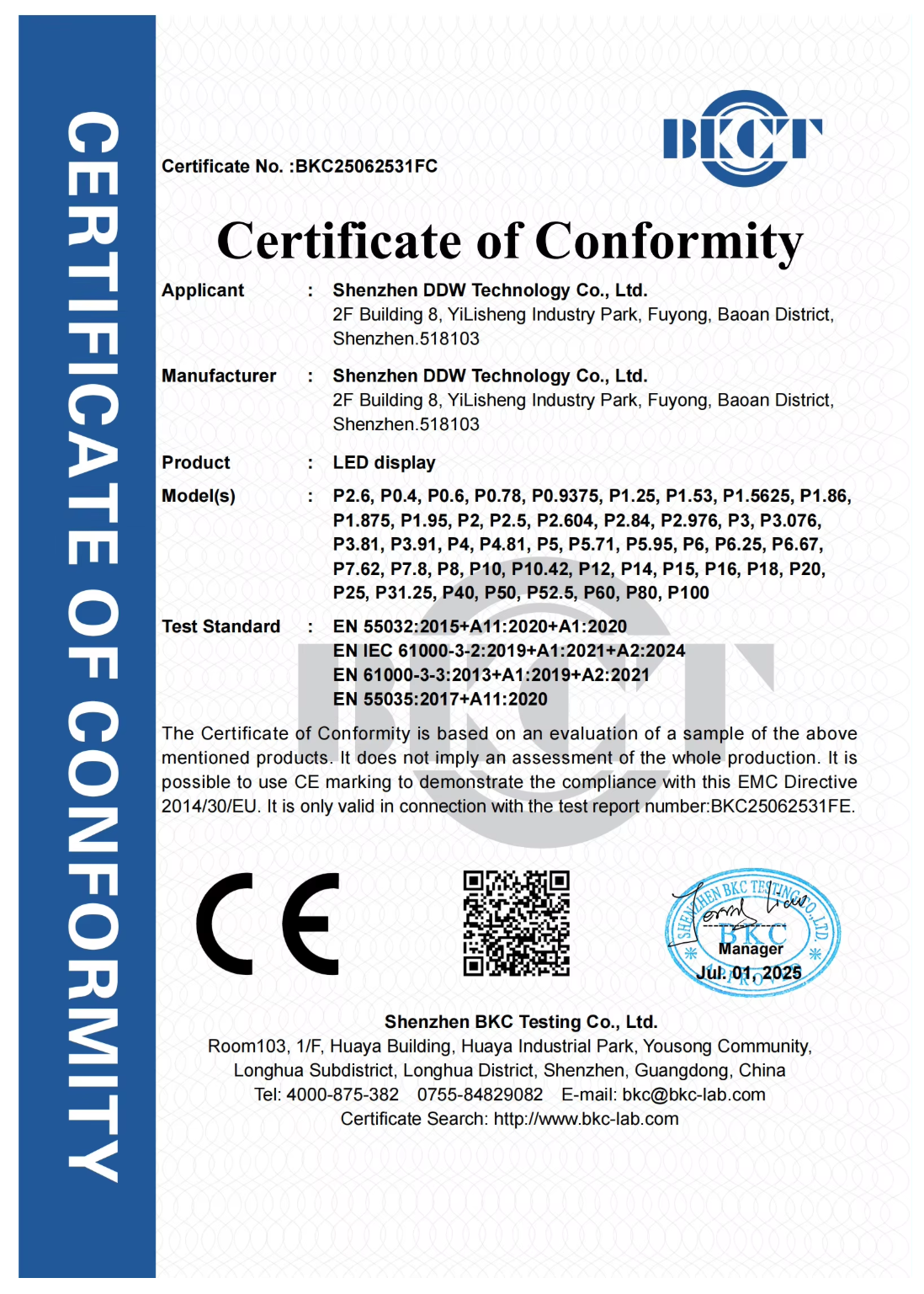 CE-EMC certificate of conformity held for DDW DISPLAY LED display products (issued 2025-07-01, valid to 2030-07-01).
A Seven-Step Configuration Workflow
The sequence below converts an event brief into a D Series configuration. It is written for a rental company or event producer who has already shortlisted a supplier and is moving into execution.
- Define the shooting plan first. Confirm whether the screen will be filmed, by what type of camera, and whether it appears in its own image. This sets the refresh requirement before pitch is discussed.
- Map the audience geometry. Sketch the seating block, balcony levels and side positions, and identify the seat with the largest off-axis angle. Compare that angle against the H160°/V140° spread to decide whether one wall is sufficient or side screens are needed.
- Set the pitch against distance. Choose from P1.56, P1.95, P2.604, P2.97 and P3.91 using the closest audience distance and the required detail, not the largest available number.
- Convert to cabinets. Divide the target width and height by 0.5 m to obtain cabinet counts, then confirm the total against transport, crew and assembly time.
- Choose hanging or stacking. Confirm rigging availability and structural responsibility at the venue, and lock the installation method into the order.
- Fix the environment and protection. State indoor or outdoor use explicitly, and require written confirmation of the protection rating for outdoor configurations.
- Verify before shipment. Request inspection and aging records, brightness and colour calibration confirmation, and the certificates applicable to the destination market and model.
Use Cases Where These Parameters Decide the Build
Concert and stage backdrops. This is the core D Series application. A documented deployment is a 20 ㎡ D Series indoor rental LED display supplied to an event organiser and stage production company in Mexico, used for indoor stage performances, live events and multimedia stage backdrops. In this context the parameter priority is usually refresh rate for camera work, viewing angle for side seating, and cabinet handling for fast load-in and load-out.
Exhibitions, conferences and brand events. Where the audience stands close to the wall, pitch becomes the dominant variable and P1.56 or P1.95 within the D Series is the more relevant end of the range. Refresh still matters if the event is streamed, and viewing angle still matters in a wide hall where visitors approach from the side.
Outdoor festivals and temporary outdoor stages. Here the configuration must combine a pitch suited to longer viewing distance with a protection rating confirmed for outdoor use. The IP65 question should be settled at quotation stage, not on site.
Fleet standardisation. A rental company buying several walls over time benefits from one cabinet platform across pitches: rigging, cases and spare parts stay common, while the pitch offered to clients flexes with the event.
Verification Before You Commit
Parameter choices are only as reliable as the production control behind them. DDW DISPLAY states 100% product inspection, aging testing, module testing, brightness and colour calibration, waterproof testing and power safety testing before shipment, with a monthly capacity of 8,000 ㎡ and stated lead times of 15–30 days for standard products, while customised projects depend on design, quantity and technical requirements. The purchasing terms published for the company list a minimum order of one unit or project-based order, with pre-shipment inspection, aging test, display performance test, brightness and colour consistency inspection, and customer video inspection or third-party inspection on request.
Compliance evidence should be matched to the market and the model. DDW DISPLAY holds a CE-EMC certificate of conformity for LED display issued 2025-07-01 and valid to 2030-07-01, an FCC Supplier's Declaration of Conformity issued on the same date, an EU RoHS 2.0 certificate for LED display, a CE-LVD certificate referencing EN IEC 62368-1:2020 + A11:2020, and ISO 9001 certification covering production of electronic products including LED display, valid to 2027-10-09. Certificates define scope, so buyers should confirm that the quoted configuration and destination market fall inside the documented scope rather than treating any certificate as universally applicable.
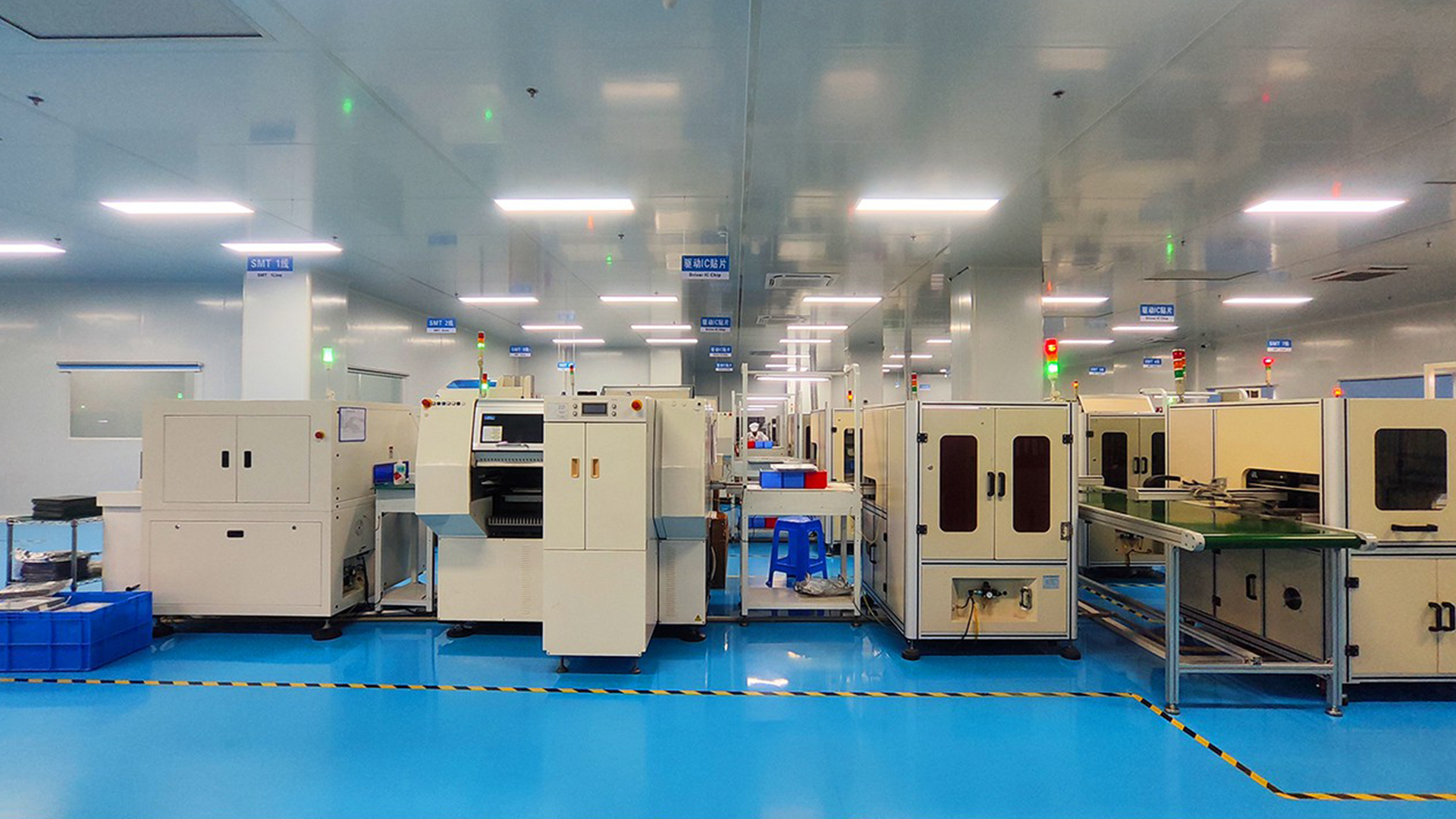 SMT production line inside the DDW DISPLAY manufacturing facility, where LED modules are assembled before aging and inspection.
Frequently Asked Questions
Which certifications should a buyer confirm for a D Series rental LED screen?
The relevant set depends on the destination market and the configuration. DDW DISPLAY holds CE-EMC and CE-LVD certificates for LED display, an FCC Supplier's Declaration of Conformity, an EU RoHS 2.0 certificate, and ISO 9001 certification covering LED display production. Certificates carry a defined scope, so buyers should request the certificate for the exact model and confirm it covers the market where the screen will operate, and evaluate certification together with aging tests, inspection records and waterproof testing for outdoor configurations.
Can a rental company order D Series screens as an OEM project for event staging?
Yes, within the documented customisation scope. DDW DISPLAY offers OEM, ODM, custom LED display manufacturing and project-based solutions, with customisation covering pixel pitch, LED module size, cabinet size, cabinet structure, display shape, brightness level, refresh rate, installation method, control system, logo branding, colour calibration, power solution and mechanical design. The minimum order is one unit or a project-based order, so an OEM configuration can be specified around a particular event format rather than taken from a fixed catalogue list.
What refresh rate does the D Series achieve, and does it need to be the maximum?
The D Series is specified with refresh rates up to 7680 Hz. That is a ceiling that depends on the driver electronics, control system and configuration ordered, so the buyer should request the refresh rate of the specific pitch and configuration being quoted. The maximum is not automatically the right setting: if the screen will not be filmed, budget may be better allocated to pixel pitch or cabinet count, while camera-heavy productions justify a higher refresh configuration.
How should the H160°/V140° viewing angle be used when planning a stage?
Treat it as geometry: roughly 80° either side of the cabinet centre axis horizontally, and roughly 70° above and below vertically. Use it to check whether the furthest side seats and the closest balcony seats fall inside the intended viewing spread, and whether side screens are needed. The angle defines where the image is intended to be viewed; it does not by itself confirm that brightness and contrast are identical at the extremes, which should be checked with the supplier and by viewing a built wall from the worst seat.
Is the D Series IP65 rated for outdoor events?
IP65 protection applies to outdoor D Series configurations where it is specified for that configuration, and it should not be assumed for every cabinet or for indoor builds. Outdoor use should be confirmed in writing at quotation stage for the exact model, together with the waterproof inspection record. Because water ingress and humidity can cause electrical faults, corrosion and module failure, installation sealing, cable protection, drainage and periodic inspection of seals and connectors remain part of the requirement.
What lead time and order quantity should be planned for?
The published lead time is 15–30 days for standard products, while customised projects depend on product design, quantity and technical requirements. The minimum order is one unit or a project-based order, and monthly capacity is stated at 8,000 ㎡. For a rental fleet expansion, the practical approach is to fix the configuration early and treat customisation scope as the variable that moves the delivery date.
Can a sample or inspection be arranged before a fleet order?
Pre-shipment inspection, aging test, display performance test and brightness and colour consistency inspection are listed as acceptance criteria, and customer video inspection or third-party inspection can be arranged on request. For a first D Series order, the most informative step is to view a built configuration under the refresh, viewing angle and pitch settings intended for the actual events, then confirm those settings in the order documentation. If that evaluation is useful, the DDW DISPLAY catalogue can be requested as a starting point, and configuration questions can be sent to info@ddw.net.
Conclusion
Refresh rate, viewing angle and cabinet parameters answer three different questions, and a rental LED screen works when all three answers fit the same event. Refresh rate decides whether the wall survives the camera, viewing angle decides whether the side and balcony seats are inside the design, and cabinet geometry decides whether the wall can be built, transported and rebuilt on schedule.
The DDW DISPLAY D Series provides a concrete reference point for that reasoning: five pixel pitches from P1.56 to P3.91, a 500 × 500 mm platform with a 0.5 m build increment, an H160°/V140° viewing angle, refresh rates up to 7680 Hz, a die-casting aluminum cabinet, and both hanging and stacking installation, with IP65 applying to outdoor configurations where specified. Buyers who confirm those values per configuration — and match them to the shooting plan, the seating layout and the venue's structural reality — are choosing on parameters that survive the first load-in.
For a full product overview, the DDW LED Display catalog 2026 is available for download, and the company's product and engineering information is published at DDW DISPLAY.
Have Questions or Need More Details?
Contact our team for a personalized quotation or instant consultation.
Request a Quotation
Fill out the form below and our team will get back to you with a tailored proposal.
WhatsApp Direct Chat
Prefer to chat in real-time? Message us on WhatsApp for instant assistance & quick answers.
- Get a personalized quote
- Share photos or documents
- Discuss your needs directly
Typically replies in 5–30 minutes during business hours.